


Introduction: Beyond Calories – A Smarter Approach to Eating
Grow weary of carefully calculating calories without feeling the scale move? You’re not alone. It may not be the amount you eat but what you eat that is the secret. What is more important than the quantity of carbohydrate you consume is its type? Here, the glycemic index (GI) will be a potent tool. Knowing the GI can transform your attitude towards the management of weight, changing the emphasis from its content to the quality of the food. We should demystify the GI and see how to apply it to intelligent, sustainable eating.
Demystifying the Glycemic Index: The Science Made Simple
Glycemic Index Definition:
GI refers to a rating system of 0 through 100, which is used to measure the rate at which carbohydrate food substances increase your blood sugar level. High-GI foods produce a sharp peak, whereas the low-GI foods are more slowly digested, resulting in a slow increase. This is a useful tool that can make you aware of the direct effect of carbs so that you can make informed decisions on how to have a more stable energy source and great management of your blood sugar levels all day long.
How the GI Scale Works: Understanding Glycemic Index Levels
Explain the three categories:
- Low Glycemic Index (55 or less): Foods in this category digest slowly. They lead to a slow and slight increase in the level of sugar in your blood, which gives a prolonged energy supply. Most non-starchy vegetables, legumes, and several whole grains are examples.
- Medium GI (56-69): The following foods have a moderate effect on your blood sugar. They break down more slowly, producing a more temporal yet regulated rise of glucose. A few fruits and whole wheat products fit in this category.
- High Glycemic Index (70 or more): These foods are quickly absorbed in the body, causing a very sharp and high spike in the blood sugar. White bread, sweetened beverages, and all kinds of processed snacks are typical examples.
CARBS are classified into a glycemic index (GI) that determines the rate at which the carbs increase the blood sugar level. Low-GI foods (such as lentils) give constant energy, and high-GI foods (such as white bread) occur. Make smarter and more energy-stabilising food selections using a GI chart to have a better health.
Why Blood Sugar Matters for Weight Management:
The spikes in blood sugar stimulate insulin, which favours fat storage. The crash after the crash then leads to a high level of hunger and desire to eat more sugary foods. When you consume foods with a low glycemic index, you have stabilised energy levels, your appetite is also regulated, and your body is even motivated to use up excess body fat as energy.
The GI Toolbox: Using the Index for Effective Weight Management
The Power of Low GI Foods for Satiety and Energy
Foods with low glycemic index (GI) have a slow digestion rate, which leads to a slow sugar spike, which means that the body gets a steady and sustained energy supply with no sudden spikes in energy level. It is also the slow digestion that keeps the feelings of fullness and satiety longer.
A low GI diet will automatically make you feel fuller, longer, resulting in reduced hunger cravings and the desire to snack, which will decrease the total amount of calories you consume each day without necessarily counting portions.
The reason is that this strategy concentrates on smarter carbohydrates such as whole grains and legumes, which means that it is a sustainable and effective approach on a lifestyle level, as opposed to being another fad diet.
The Problem with High GI Foods and Weight Gain
High glycemic index foods lead to spikes in blood sugar. This causes your pancreas to secrete a rush of insulin. This hormone makes your body store the excess sugar in the form of fat and ruins your metabolism by encouraging the body to store energy as soon as possible instead of burning it as fat, thus causing weight gain in the long run.
Beyond Weight Loss:
The low-GI diet has some formidable non-weight management advantages. It assists patients with diabetes in having stable blood sugar levels. The health of the heart is also promoted by this type of eating by raising the levels of cholesterol and decreasing cardiovascular risk factors. In addition, it gives a longer-lasting energy, eliminating the peaks and the fluctuations of high-glycemic food, and making you long and alert all day long.
Your Practical Guide to Low-Glycemic-Index Foods
Building Your Low-GI Plate: A Comprehensive Low-Glycemic-Index Foods List
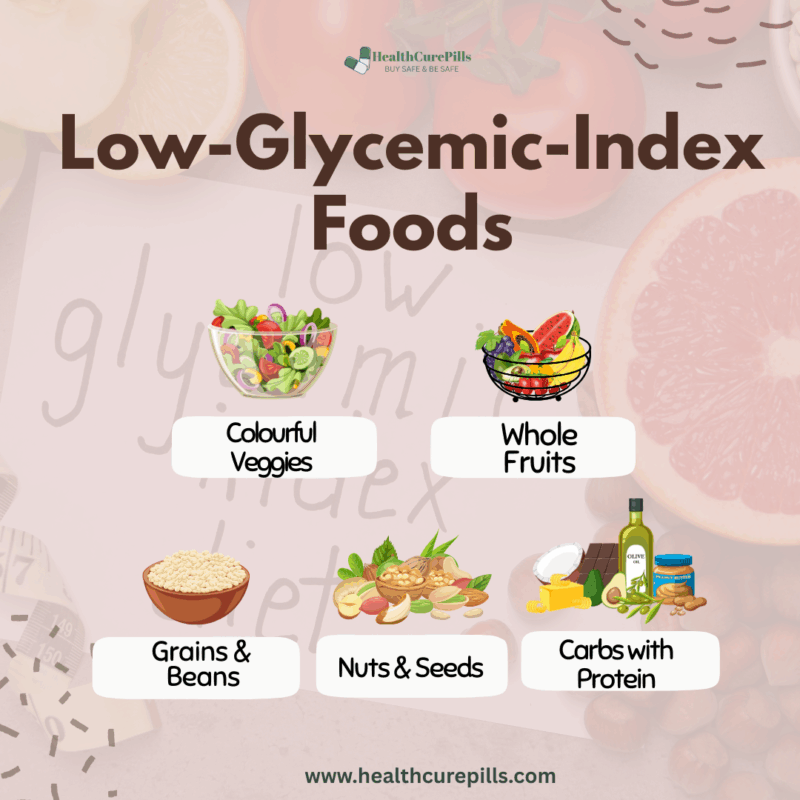
- Fill half your plate with colourful veggies. Green leafy foods work well. Try broccoli and carrots too. Sweet potatoes are good sometimes. Just be careful with high-GI types. Limit russet potatoes, for instance.
- Always pick whole fruits. Apples, oranges, and berries are best. They have low GI and lots of fibre. Eat high-GI fruits, like watermelon, in small portions.
- Build meals with fibre-rich grains and beans. Quinoa, lentils, and firm pasta work well. Start your morning with oats. Steel-cut or rolled oats are great. They give you energy that lasts. This energy stays with you for hours.
- Each meal needs healthy fats and protein. Add nuts, seeds, and avocado. Mix them into salads. Or eat them as snacks. These foods help your blood sugar stay steady.
- Foods change your blood sugar. Pair carbs with protein or healthy fat. This really helps. Your blood sugar will be much steadier.
The Rice Conundrum: Making the Right Choice
A dedicated section on a common staple. Compare:
Rice choice also plays an important role in blood glucose. Comparison of the popular varieties can be presented as the following list on the scale of glycemic index (GI).
- Brown rice has a moderate GI of about 68. Its high fibre content slows down the rate of digestion, thus ensuring that glucose is released slowly as compared to its white counterparts.
- Basmati rice is suggested in case of a lower-GI white rice. It is a wiser energy source with its distinct starch composition, with a glycemic index of between 50 and 58.
- White rice is a high-GI food, which often has a score of 70-89. The digestion destroys the fibrous bran and germ, and the end result is the rapid digestion and the sharp increase in the blood sugar.
- Jasmine rice is usually high-glycemic in nature, similar to or higher than regular white rice; thus, it is to be taken sparingly.
- The idea of forbidden rice, also known as black rice, is a good choice to make as the glycemic index of it is approximately the same as that of brown rice. It also contains positive antioxidants.
To find low-glycemic-index (GI) rice, find particular varieties that have been tested. Whole-grain consumer goods that contain high levels of amylose, a form of starch that is slow to digest, tend to be the most favourable options. Uncle Ben’s Converted Rice is one of the lowest GI substitutes. The least glycemic effect can be achieved by choosing particular kinds like Doongara rice or some long grain brown rice varieties, and always combining it with some protein and healthy fats to react the best.
The Sweeteners Spectrum:
The glycemic index (GI) is one of the factors to consider when selecting a sweetener. Sucrose (white sugar) has a medium GI of about 65. Raw maple syrup has a little lower GI, usually about 54. It is worth noting that most types of honey have a GI similar to that of sugar, ranging from 58 to 65. Being a whole-food alternative, Medjool dates have a low to medium GI, which is estimated at 45-55 on average, which makes them a favourable and nutritionally-dense food that could be used to provide lasting energy.
Navigating High GI Foods
Not All High GI Foods Are “Bad”: The Context Matters
Although watermelon and pumpkin have a high glycemic index (GI), they are not harmful. These are foods that are of great essential nutrients such as vitamins, antioxidants, and fibre. It depends on context as the key to their beneficial effect. A modest size of the portions greatly minimises their effects on the blood sugar. Moreover, they can be paired with a protein source or nutritious fats; e.g., pumpkin seeds may be added to a meal, or watermelon and cheese may be eaten together; this will significantly slow down digestion and allow blood glucose levels to increase more gradually.
Decoding Popular Foods: Glycemic Index of Common Items
Create a mini glycemic index food chart section, answering specific queries:
- Sourdough bread usually has a lower glycemic index value, standing at about 53, than white bread, which has an average of about 75; thus, it is a wiser choice.
- In fruits, blueberries have a low glycemic index (c. 53), bananas (c. 51), and grapes (c. 59) have a low to medium index; a mature mango has a medium index of 51-56.
- To maximise blood glucose regulation, use rolled or steel-cut oatmeal, with a low or medium GI of about 55, instead of instant ones.
FAQ Glycemic Index
Q: What is the low glycemic index (GI) number?
Foods are categorised on a scale of 0 to 100 by scientists.
A low GI value is 55 or less. The food types in this category produce a more gradual, slower increase in blood sugar levels.
Q: What are examples of extremely low GI foods?
The GI of even most whole, unprocessed foods is indeed very low.
The best examples are the majority of non-starchy vegetables like broccoli, spinach, tomatoes, legumes (lentils, chickpeas), nuts, and seeds.
Q: What is the way can scientists calculate the glycemic index of a certain food?
They quantify it by means of controlled human studies.
Once volunteers eat a food sample that includes 50 grams of digestible carbohydrate, researchers measure their blood sugar levels at a set frequency within a two-hour time frame and compare the data with how their body responds to pure glucose.
Q: Do all people benefit from a low GI diet?
Although low GI foods are a healthy choice for most people, people do not have to adhere to a low GI diet.
This method is most important to help individuals with diabetes or prediabetes and to control sugar levels. For others, the overall quality and balance of your entire diet matters more than the GI of each food.
Integrating GI into a Holistic Weight Management Lifestyle
The GI is a Tool, Not the Whole Toolkit:
The glycemic index helps you pick smarter carbs. It is a good tool. But it’s not a full answer. To manage your weight, focus on eating good food. Also, eat the right amounts. Keeping your calories balanced over time is key. Use the GI to fine-tune your food choices. This should be part of a bigger plan. Don’t make it your only diet.
The Powerful Synergy: Combining Diet with Activity
Frequent weight loss training is actively involved in the management of blood sugar by the body, and a large part of the insulin sensitivity. This enhances the efficiency with which your system processes your meal carbohydrates. More so, practices such as mindfulness, such as weight loss yoga, are effective in reducing cortisol and fighting eating caused by stress. If this stems from the usual propensity to grab high-GI comfort foods straight into their mouth, your weight management ambitions will have a better-balanced and more comprehensive approach to it.
A Note on Medical Interventions:
Remember that a balanced diet and regular exercise form the cornerstone of sustainable weight management. Some people might be advised by a doctor to utilise supplementary services, e.g., the drug orlistat (Xenical). This prescription operates by inhibiting the absorption of fat in the diet, and entirely different mechanism compared to the Glycemic Index. Such pharmaceutical interventions should only be undertaken under strict medical supervision as this is an adjunct to, but not a substitute for, the underlying lifestyle changes.
Conclusion
Knowing the glycemic index enables you to make better food decisions. Choosing low-GI carbohydrates, you will be able to be full longer, be able to keep your energy levels at a certain level, and, on the other hand, maintain your weight management goals. Begin by doing one easy replacement, like substituting white rice with basmati rice that is nutty. This knowledge should not be taken as a strict diet but as an effective guide to create a sustainable and healthy eating pattern that will provide your body with the fuel and your well-being with power in the long run.